Features
Name:
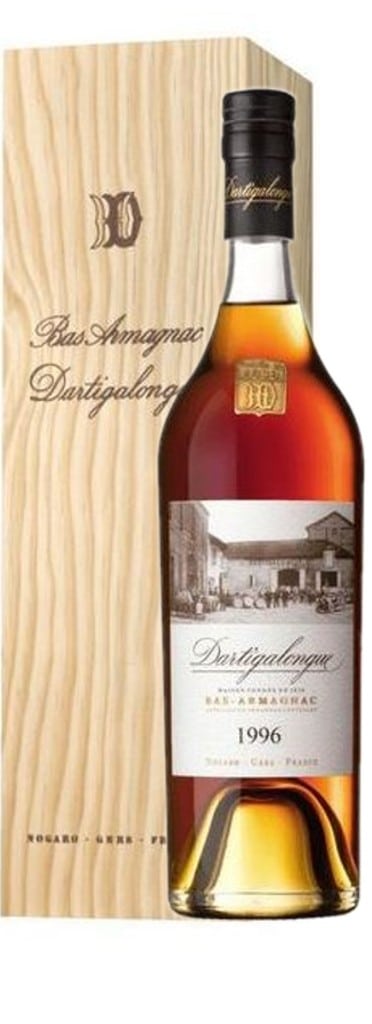
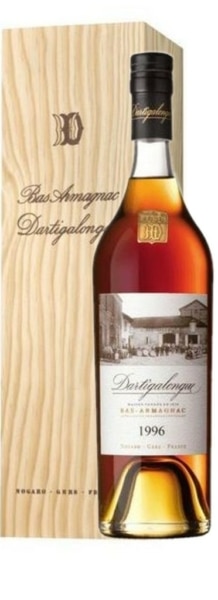
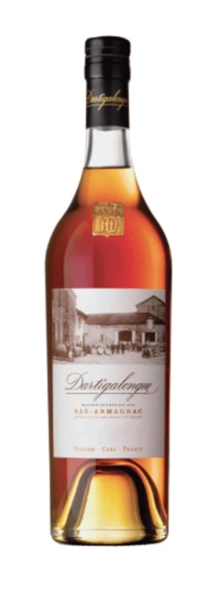
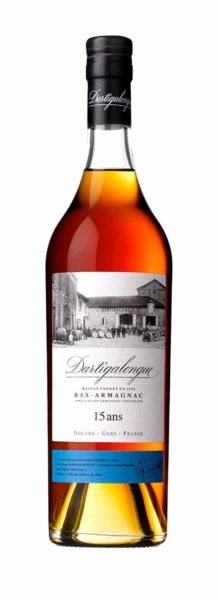
Bas Armagnac Millésimé 1993 Dartigalongue c. wood
Terrain:
sandy, poor in limestone and rich in marine sediments
Cellar
It was in 1817, during the reign of Louis XVIII, that Pascal Dartigalongue was born. Coming from a family of wine growers based in Saint Lannes near Madiran, he spent his childhood in the heart of vineyards surrounded by wine and 'Eau-de-Vie'.
(as Armagnac was called at the time).
In 1838, during the reign of Louis-Philippe, he settled in Nogaro thanks to the 10,000 gold Francs his father gave him from his share of the family business, which he had to leave to his elders. His beginnings were hard, but he soon realised that Armagnac was an export product. His Armagnacs, sold in barrels, found markets in Belgium, Holland, England and even as early as the USA.
His business prospered and sales flourished when his grandson Joseph took over in 1870. This change saw a rapid progression for the house, helped by the creation of the railways. Export sales of Armagnac no longer depended entirely on the port of Bayonne. A few kilometres from Nogaro, caravans were loaded and pushed on to the northern European capitals of Rotterdam, Antwerp, London and Hamburg.
Phylloxera arrived in Gers in 1880 and gradually destroyed a large part of the Armagnac vineyards. It was a difficult decade for Joseph.
In the 1890s, the French economy was flourishing: Paris became an important financial centre and the consumption of alcohol was never more important. Joseph, whose health was fragile, decided to hand over the business to his two sons André and Henri.
In the midst of the "Belle époque", André created an agency to represent the company in Paris, while his younger brother Henri remained in Nogaro to direct production. This strategy was highly successful, as by 1906 vintage DARTIGALONGUE Armagnacs were on the menu at the Café de Flore, the Edouard VII, the Café Riche and many other prestigious and luxurious Parisian hotels.
In 1914, André and Henri had to leave for the war and so his father Joseph took over the running of the house. At the end of the war in 1918, André was seriously wounded and Henri contracted a lung disease that greatly reduced his business.
A very young Pierre, Henri's son, took over the management of the company in 1930. Sales of bottles grew, first in France and then in export markets. In 1936, he was very successful in the United States and travelled regularly on the Le Harve-New York transatlantic line. It formed a partnership with one of New York's most important distributors that lasted for several decades.
After the Second World War, Pierre continued to develop the American market and also started to address Europe with Belgium, Holland, Sweden and Norway.
In the 1980s, he handed over the reins of the house to his son Jean-Pierre and daughter Françoise. Jean-Pierre developed the European markets (Spain, Italy), then the United States in the early 2000s. Françoise was in charge of structuring sales in France to gourmet wine shops, delicatessens and restaurants, reinforcing the DARTIGALONGUE brand image on a national level
In 2010, Françoise DARTIGALONGUE, then head of the company, convinced her niece Virginie's husband, Benoit Hillion, to leave his job as an agronomist in Paris to settle in Nogaro and take over the business. Fascinated by the history of the house and by Françoise's enthusiasm and optimism, Benoit immediately set about and galvanised the development of the house. He participated in several trade fairs and found new partners in Japan, Australia, Russia and China. At the same time and continuing Francoise's work, he also travelled around France meeting customers, wine and spirits merchants and restaurateurs who were increasingly appreciative of DARTIGALONGUE's history.
Description
Since the 19th century, the DARTIGALONGUE family has been selling vintage Armagnac. The vintage corresponds to the year of the harvest. The youngest vintages sold by DARTIGALONGUE are aged for at least 15 years in 400-litre oak barrels. Each vintage is unique and has its own personality. Bas Armagnac from 1996 is rich, intense and velvety, with dried fruit aromas and a very fine, long finish.
Organoleptic characteristics:
On the nose there are notes of caramelised fruit, roasted dried fruit, citrus peel, hints of cocoa and almond. In the mouth it is mellow, round, intense, velvety, soft with notes of dried fruit and a very fine, long finish.
Storage time:
over 30 years
Vinification
vinification in old Guasconia oak barrels
Acknowledgements