Features
Name:
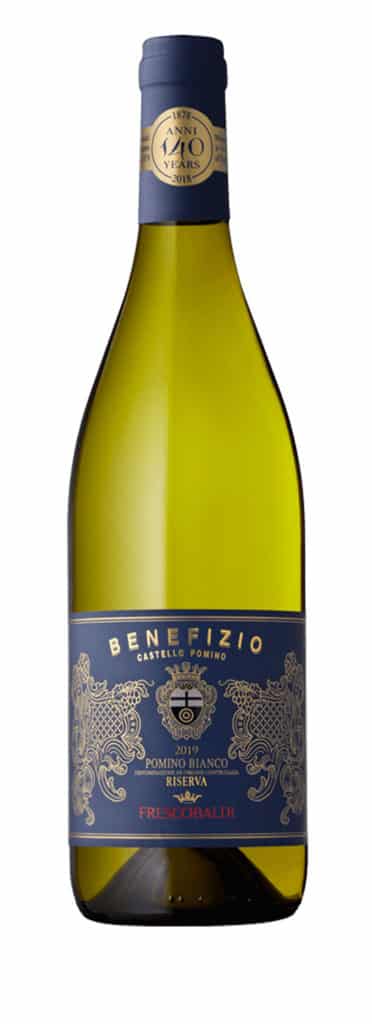
Benefizio Frescobaldi Pomino Bianco Riserva DOC 2023
Terrain:
marl, clays and Pliocene sands
Cellar
Commitment to viticulture and agriculture in general, these are the strengths of the Frescobaldi family, which has been producing wine in Tuscany for seven hundred years, precisely since the early 14th century. The family also counts among its ancestors illustrious men of letters, explorers, musicians, bankers, bishops and politicians. The archive holds numerous ancient documents and the records include commercial contracts with many European courts from the 13th century onwards. In the 15th and 16th centuries, the Florentine house supplied wines to the Court of England and many European countries, including the Papal Court. Even earlier, the Frescobaldi maintained relations and business contacts with the workshops of various famous artists including Donatello, Michelozzo Michelozzi and Filippo Brunelleschi.
Around the year 1000, the first members of the family moved to Florence from Val di Pesa, where we still find the Castiglioni Estate, the oldest agricultural estate of the family. At that time, the cities of central-northern Italy were becoming economically, politically and militarily stronger, to the detriment of feudal power; the lords in fact became urbanised, attracted and flattered by the commercial and political advantages that the cities offered.
The Frescobaldi settled in the Oltrarno part of the city in Piazza de' Frescobaldi where they built the loggia, tower and palace. In 1252, Lamberto Frescobaldi built the first wooden bridge over the Arno, now called Ponte Santa Trinita so as to connect his possessions with the ancient centre of Florence.
With great openness towards the future, the ancestors introduced then unknown grape varieties to Tuscany in 1855, including Carbernet Sauvignon, Merlot Pinot Noir and Chardonnay.
The 20th century was characterised by the actions of Vittorio, Ferdinando and Leonardo Frescobaldi, who made an important contribution to elevating Tuscany to a place of excellence for viticulture.
Today, Lamberto Frescobaldi has picked up the baton, who, on the strength of his long technical experience, aims to further strengthen the uniqueness of the wines of each family estate.
Description
On the road to Pomino, you can see hills and cypress trees that suddenly give way to steep slopes, cooler temperatures in summer and snow in winter, magnificent fir and sequoia forests that surround the vineyards of Chardonnay, planted here since 1855. At an altitude of 700 metres, the Cru Benefizio, Italy's first white wine fermented and matured in barriques, was born in 1973.
Organoleptic characteristics:
Brilliant straw yellow colour with golden highlights is a prelude to a beautiful structure. The bouquet ranges from fruit to flower to spice and ends with delicate tertiary notes. The initial citrus scent, reminiscent of candied orange peel and pink grapefruit, merges with the tropical scent of pineapple. The floral notes, which appear later, are reminiscent of acacia, mimosa and magnolia. Time gives a continuation on vanilla, cinnamon, toasted hazelnut and the pungent tingle of ginger. The palate confirms its unquestionable elegance, revealing itself to be structured, creamy, savoury and with a solid, long finish.
Storage time:
5 years
Vinification
The Chardonnay grapes were harvested in boxes by hand with extreme care and attention. Once they arrived in the cellar, the pressing they underwent was extremely soft and delicate, already allowing a good extraction of clear must, which was further clarified after cold decantation. The musts thus obtained were placed in barriques, for the 50% new and for the 50% first-passage, where they underwent alcoholic fermentation and only partially malolactic fermentation.
Acknowledgements
Luca Maroni94/100