Features
Name:
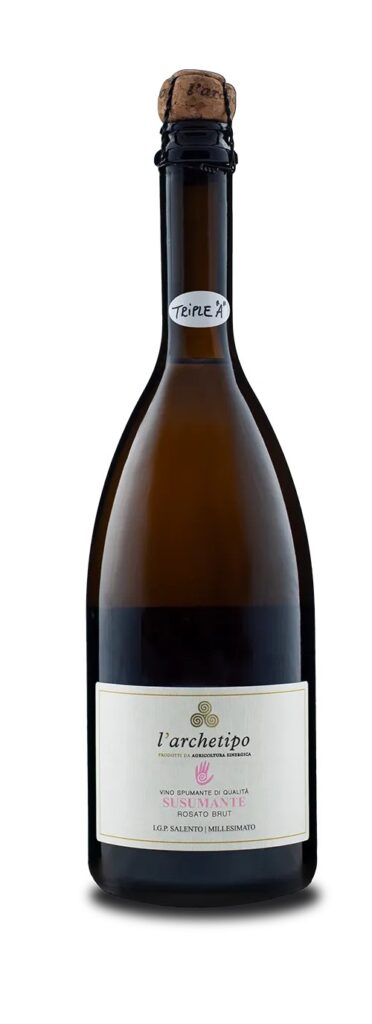
Susumante Rosé Brut Millesimato Ancestrale L'archetipo
Terrain:
clayey-loamy with considerable presence of siliceous pie-triscum and humus.
Cellar
Located in the Castellaneta countryside, at the foot of the Bari Murgia, it was founded by Francesco Valentino Dibenedetto, a farmer from birth, who later also became an agronomist. As early as the 1980s, he began converting the farm to organic farming, moving on to biodynamic practices in 2000. After a few years, he realised that there was still something standing in the way of a return to the archetypal situation of the soil, the ecosystem and thus also the vineyard. Inspired by the non-interventionist practices of Masanobu Fukuoka, in which the synergies between all the rings of the ecosystem are triggered, he switched to synergistic agriculture, for which, among other things, ploughing is no longer practised.This new adventure developed together with his wife Anna Maria and his four children: Carlo Nazareno, Domenico, Andrea, and Maria Clelia. It is thanks to the constant and responsible commitment of all of them that it was possible to build the current wine cellar, all in tuff, where in these precise climatic conditions it is possible to valorise the prized estate grapes without the use of chemicals. The entry into the company of the new generation, under the guidance of Francesco Valentino's wealth of experience, can only give impetus and vitality to the archetype.
Description
Susumante Rosé Brut Millesimato della cantina L’Archetipo è uno spumante ottenuto con metodo ancestrale da uve Susumaniello, lavorate con pressatura soffice e fermentazione spontanea grazie all’impiego di lieviti indigeni. Non filtrato. Minima aggiunta di anidride solforosa in pre-imbottigliamento. Il vino non è filtrato né chiarificato e presenta una minima aggiunta di solforosa prima dell’imbottigliamento.
Organoleptic characteristics:
Colore rosa cerasuolo intenso, con perlage vivace e persistente; al naso emergono note fruttate e floreali ben definite. Al palato è morbido, sapido e sostenuto da una piacevole acidità che ne prolunga la freschezza.
Storage time:
5 years
Vinification
La fermentazione avviene spontaneamente grazie a lieviti indigeni, a basse temperature, preservando al meglio le caratteristiche del territorio. Prima del completo esaurimento degli zuccheri, il mosto viene trasferito in autoclave dove avviene la presa di spuma, seguita da sei mesi sui lieviti con bâtonnage. Il vino non è filtrato né chiarificato e presenta una minima aggiunta di solforosa prima dell’imbottigliamento.
Acknowledgements