Features
Name:
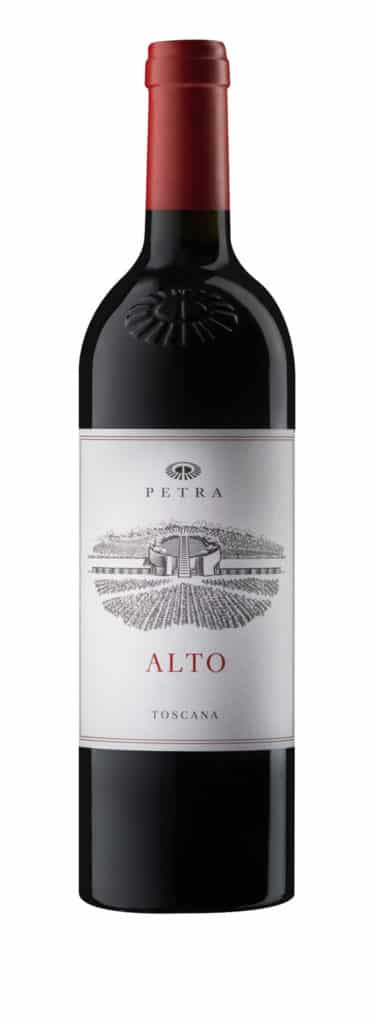
Alto Petra Toscana IGT 2018
Terrain:
ferrous-clayey, rich in skeleton
Cellar
Starting with Élisa Bonaparte and ending with Francesca Moretti, it is more than two hundred years that the path of Petra has had a feminine step.
In 1808, Elisa Bonaparte Baciocchi, Napoleon's sister, Princess of Lucca and Piombino and Grand Duchess of Tuscany, chose this place to establish the first nucleus of an agricultural and wine-growing project. Two centuries later, during a road trip to Bordeaux with her father Vittorio, Francesca Moretti fell in love with the history and culture of the chateaux and decided to put aside the idea of becoming a veterinarian to study agronomy and oenology, immediately starting the search for a property to convert into a Bordeaux-style winery. Tuscany was perhaps an obvious choice in the years (the late 1990s) of his oenological renaissance, but not so obvious was the intuition to focus on the Maremma, not the Bolgheri area, but the fertile Val di Cornia, with the collaboration of an explorer of excellence like Attilio Scienza.
It was in 1997 that Vittorio Moretti bought 60 hectares in San Lorenzo and 45 in Campiglia Marittima, a few kilometres from Piombino, in Suvereto. It was a seed, the beginning of a profound and contemporary project. This is how the idea of Petra was born. It is here that Francesca Moretti has found her second home. A home in its own right, loved as much as her Franciacorta.
Description
Alto represents one of the most marked expressions of the territory.
Its geological and microclimatic characteristics are clearly expressed through a grape variety, Sangiovese, that has its home in Tuscany.
Organoleptic characteristics:
The colour is bright ruby, the aromas centred on sensations of undergrowth, humus, small red fruits and violets, accompanied by a mineral vein in the background.
The taste denotes freshness and savouriness, elegance and complexity, yet with a certain vigour.
Storage time:
3-6 years
Vinification
Fermented in truncated oak vats, fermentation is accompanied by a long maceration on the skins
Acknowledgements